Room to Roam: Why a Long Line Might Be the Kindest Bit of Kit You Own
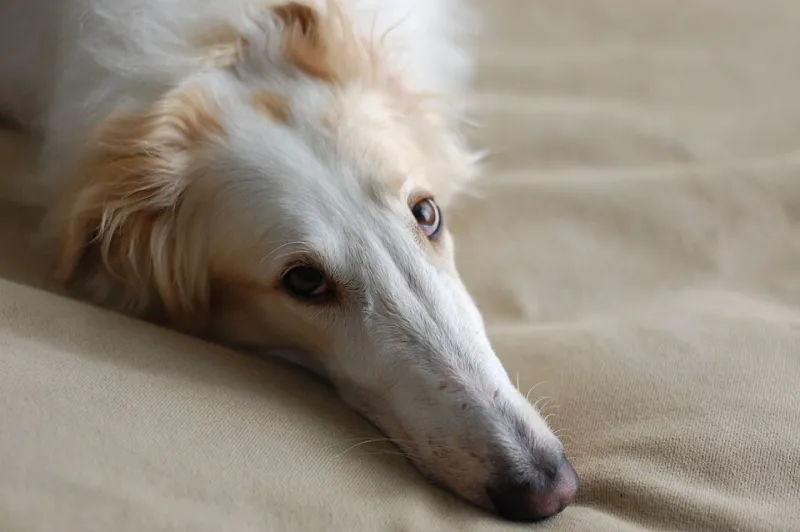
Photo: ROVER_JP, CC BY 2.0, via Wikimedia Commons
There is a particular kind of walk I love: a wide field, a soft path, no sheep in sight and a dog with room to think. Not a dog dragging me towards the horizon, you understand. Just a dog allowed to pause, sniff, circle back and take the long way round a tuft of grass. It is amazing what opens up when you swap the short lead for a long line.
This is not a campaign to let every dog off lead everywhere. Far from it. It is a quiet argument for a piece of kit that sits somewhere between total freedom and a tight six-foot walk: the long line. Used well, it gives dogs more dog-ness while keeping them — and everyone else — safe.
What a long line actually gives your dog
A standard lead is brilliant for pavements, car parks and busy places. But in a big field, a short lead can turn a walk into a series of small tugs. The dog wants to investigate a scent; the lead says no. The dog wants to move at a different pace; the lead says no.
A long line changes the conversation. Your dog can wander a few metres ahead, dip into the grass, follow a promising smell and still be attached to you. That extra space matters. Sniffing is not a distraction from the walk — for many dogs, it is the walk. It lowers the heart rate, tires the brain and gives them information about the world.
And for owners, a long line is a useful bridge. It is a way to practise recall, test a dog’s focus and build trust in open spaces without simply hoping for the best.
Choosing a line that suits your hand (and your dog)
You do not need anything fancy. A simple, well-made long line — usually between five and ten metres — is enough for most everyday walks. Biothane and lightweight webbing are popular because they are easy to wipe clean and less likely to soak up mud. Rope-style lines are fine too, though they can be harder on the hands if your dog suddenly hits the end.
Skip anything with a flimsy clip or a thin cord that could cut into your hand. A padded handle or a small wrist loop helps, especially on wet days. And do consider a line with a few knots or markers along its length; they make it easier to judge how much slack you have.
Size matters. A giant breed needs a sturdier line than a whippet, but heavier is not always better. A line so heavy it droops and tangles is a nuisance. Aim for something strong, light and comfortable to hold.
The harness question
A long line works best with a well-fitted harness rather than a collar. If your dog does hit the end of the line, a harness spreads the pressure across the chest and shoulders instead of the neck. That is kinder and safer.
Look for a harness that allows a full range of movement, does not rub behind the front legs and cannot be backed out of. Y-front harnesses are a good starting point for many dogs. If you are unsure, ask a qualified trainer or a good independent pet shop to check the fit — a harness that slips or chafes is worse than no harness at all.
Teaching a loose line, not a tightrope
A long line is not a tow rope. The aim is slack, not tension. If the line is permanently tight, your dog is effectively still on a short lead, just with more to trip over.
Start somewhere boring: a quiet park, a wide path, a familiar field with no livestock. Let the line out gradually. When your dog reaches the end, stop and wait rather than yanking. Most dogs quickly learn that pulling does not unlock more space. Reward them for checking in — a bit of cheese, a toy, a cheerful “good lad” — and keep the sessions short.
Practise picking up the line neatly, too. A long line has a talent for finding mud, ankles and the only puddle for miles. Coiling it loosely as you walk helps, and a simple figure-of-eight around your hand is safer than wrapping it round your wrist.
Recall that works in the real world
A long line is a brilliant place to build recall because you have a safety net. But it does not teach recall on its own.
Start with a word your dog already knows — their name, a whistle, “here” — and reward heavily when they turn. Practise in low-distraction places first. Then add small distractions: a friend standing nearby, a scatter of treats in the grass, a quiet corner of a busy park.
Never call your dog only to put them back on the lead. If every recall ends the fun, they will learn to ignore you. Call, reward, release them again. Make coming back the best part of the walk.
When someone else appears
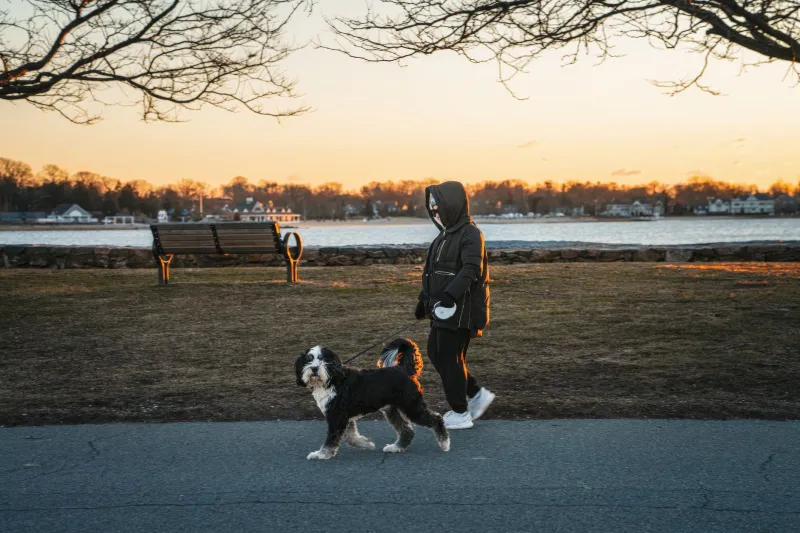
This is the bit that puts many owners off. A dog on a long line sees another walker, a cyclist or a dog, and suddenly you are managing several metres of line and a hopeful Labrador.
Have a plan. As soon as you spot someone, shorten the line calmly and bring your dog close. Reward them for being with you. You do not need to apologise for existing — a cheerful “morning, we’re just practising” is usually enough. If the other person has a dog on lead, give them space. If they have a dog off lead, be ready to step off the path and keep your dog close.
A long line should never be used to let your dog charge up to strangers. The extra room is for sniffing and exploring, not for ambushing the postman.
The places to leave it in the bag
A long line is not for every walk. Keep it for open fields, quiet footpaths, secure parks and places where you can see what is coming. Do not use it near roads, in crowded spaces, around livestock or anywhere your dog could tangle with wildlife. In lambing season, on farmland with sheep or near nesting birds, a short lead is the kind choice. The Countryside Code is clear for a reason.
And if your dog is reactive or easily overwhelmed, a long line can still be useful — but get advice first. It is not a shortcut to off-lead freedom; it is a tool that needs a bit of thought.
A small shift, a bigger life
Nobody is suggesting you turn every walk into a wild adventure. But a long line, used sensibly, can make an ordinary field feel like a proper outing again. Your dog gets to sniff, choose and move. You get to keep control. The walk becomes a shared thing rather than a short, tight loop.
In 2026, with so many of us walking the same local routes, that small bit of extra room might be the kindest thing we can offer our dogs. Not endless freedom. Just enough to let them be dogs.