Cardboard Season, Calm House: A Dog’s-Eye Plan for the December Delivery Rush
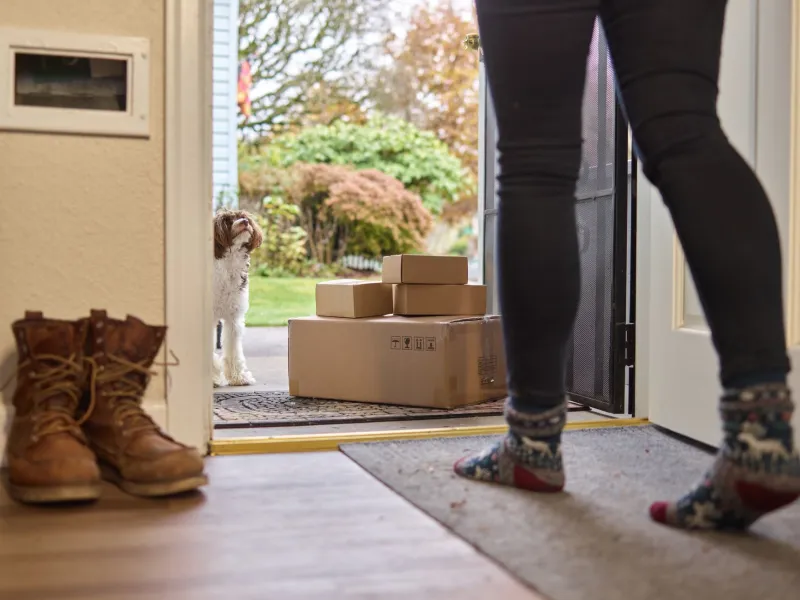
December has a sound of its own. Not just carols and fairy lights, but the thump of a cardboard box on the step, the rattle of a letterbox and the doorbell going off before you have even found your slippers. For many dogs, it is not the parcels that are the problem. It is the unpredictable, repetitive interruption to their home. The front door suddenly becomes a portal of suspense, and every delivery is a small event that asks them to decide: bark, bolt, guard, or worry.
Here at Beautiful Dogs, we are all for a festive season that works for the whole household — including the four-legged member who did not ask for a daily visit from a stranger in a high-vis jacket. The good news is that a calmer December does not require military precision. It needs a few sensible tweaks, some gentle practice and a little kindness towards the people doing the delivering.
The front door is the pressure point
Most dogs are not reacting to cardboard. They are reacting to a pattern: a sound, a stranger, a movement outside, then a big change inside. Add in darker afternoons, more people at home, extra visitors and the general hubbub of December 2026, and it is easy to see why the doorbell can feel like a fire alarm to a sensitive dog.
Start by looking at your hallway with fresh eyes. Is there a clear route to the door that does not involve stepping over a dog bed? Can you create a safe zone behind a baby gate, in a separate room or behind a crate cover, where your dog can settle with a chew and still hear the house without being in the firing line? A lot of door-related drama is solved by simple geography.
If you have a smart doorbell or an indoor chime, turn the volume down or switch to a quiet notification on your phone. If parcels usually arrive in a predictable window, pop the dog in their safe space a few minutes beforehand. This is not exclusion. It is giving them a job that suits them: resting, chewing, and not practising the fine art of launching themselves at the letterbox.
Make the bell mean something better
Training does not need to be a formal session. It can be two minutes in the kitchen while the kettle boils. The aim is to change the emotional charge of the doorbell from alarm to anticipation — not by flooding your dog with knocks and chimes, but by pairing the sound with something genuinely good.
Try a simple game. With your dog at a comfortable distance, play a doorbell or knock sound at a low volume on your phone, then immediately scatter a handful of treats on the floor. Repeat a few times, keeping the sound quiet enough that your dog notices but does not panic. Over several days, gradually increase the volume or move closer to the door. If your dog stops eating or tries to leave, you have gone too fast. Go back a step.
For dogs who like a bit of thinking, add a small ritual: doorbell sounds, then a treat lands in their bed. Doorbell sounds, then a scatter in the hallway. Doorbell sounds, then you walk calmly to the door and back without opening it. The message is not that nothing ever happens. The message is that the sound predicts something manageable, and that you are the person who handles the door.
Brief the couriers without a lecture
Posties and couriers are doing a hard job in December, often in the dark and the rain, with more parcels than any reasonable person should have to carry. A short, friendly note on the door can work wonders. Something like: ‘Dog in home. Please leave parcels in the porch or safe box. No bell needed — thank you!’ Keep it polite, clear and waterproof.
If you have a regular courier or postie, it is fine to say hello and explain that your dog is in training. Most people are happy to use a knock rather than the bell, or to leave a parcel without waiting for an answer. What is not fair is letting a dog rush the door, jump at a visitor or make someone feel unsafe. Responsible ownership means managing the dog, not expecting the rest of the street to manage them for you.
A secure porch, a lockable parcel box or a clearly marked safe place can take the sting out of the whole exchange. Redirecting deliveries to a local shop or click-and-collect point is another quiet hero of December. Fewer doorbell moments is not a failure of festive spirit. It is good planning.
When the barking has already started
If your dog barks at the door, resist the urge to shout. Shouting adds energy to an already noisy moment and rarely teaches the right lesson. Instead, create distance. Move your dog away from the door, reward them for coming with you, and give them something to do — a snuffle mat, a frozen enrichment toy, or a chew in their safe space. The aim is to interrupt the pattern, not to win an argument.
It also helps to tell neighbours what is happening. A brief note or a chat over the fence can turn irritation into understanding: your dog is in training, December is noisy, and you are doing your best. Most people appreciate the honesty. If you are out during delivery hours, consider a camera or a trusted neighbour who can collect parcels without setting off a chorus.
A shared calm is the real festive win
A dog who can hear the doorbell without unravelling is not just a nicer neighbour. They are a dog who feels safe in their own home. That is worth a little planning, a few treats and a polite note on the door. This December, let the parcels pile up by all means — but let the barking, bolting and stress stay outside. Good owners make festive seasons easier for everyone: dog, postie and neighbour alike.